
Fawn The Florist
Developed by: Harvey Yeo, Evan Puah, Sean Ng, Tommy Pham, Emily Cosson,
Jon Tai, ZiXin Fu (Frank), Cameron Bowes, Adrian Lai,
Randy Zhang, YuXuan Hu (Jarvis Hu)
Project Roles: Game Designer (Level and Quest Systems), Soft Programmer (Level and Quest Systems), Music Direction assistance, Sound sourcing, Quality Assurance


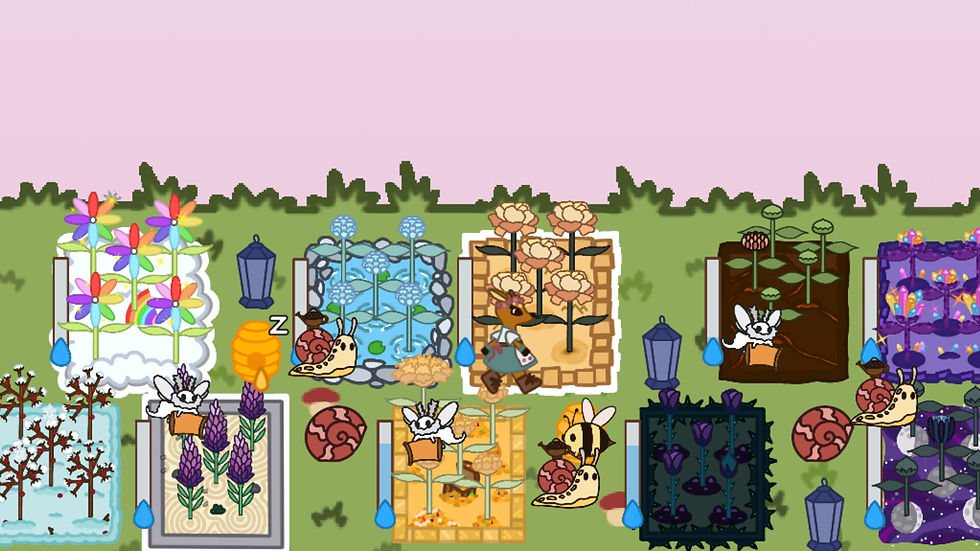
Fawn The Florist
Details of contributions
Fawn the Florist is a cozy, idle game that sits at the bottom of your screen acting as your peaceful garden space the player tends to while you work, study or relax.
The gameplay loop revolves around planting, harvesting and selling flowers, unlocking new varieties as players progress.
This Unity game is my capstone project (final year project) in QUT and was fully released on Steam for free on 21 Nov 2025.
The concept of the game was proposed by my teammate Emily and gameplay ideas were fledged out by the team. Throughout development, its scope, mechanics and gameplay loop was revised.
For the version 1.0 release on steam, I implemented and co-designed the game's quest and level systems.
The music in our game was outsourced and produced by Mitchell Stewart, a friend of one of our teammates. My contribution to the final music soundtrack of our game would be providing the direction of the music, such as thematic feel and instruments used.
I sourced the sound effects for our game on stock asset websites such as Pixabay and Freesound.org using available assets under the creative commons license.
Development Process
Our defined target audience was time-poor, stressed individuals seeking a relaxing, low-commitment gaming experience. This idle game would act as a brief escape for them to de-stress while they are studying or dong simple work tasks.
To appeal to these players, the experience we intended to create was akin to a "Virtual Bubble Wrap" that provides players with delightful visuals. The "virtual bubble wrap" is presented by having players constantly click on parts on the game screen. Such as clicking to: plant, water flowers, harvest and collect coins. All these interactions are backed up by animated visual flairs to create satisfying feedback.
Shelved Concepts
In the earlier Stages of development, the gameplay loop was much more complex, requiring more steps from planting the flowers to selling them. This mechanic was the Bouquet Mechanic. This mechanic allowed players to arrange flowers in their bouquet, and earn profits based on how they arranged it.
The intention of this mechanic was to provide a multitude of ways for players to approach the game. The opportunity to optimise for profit would give more gameplay time while bringing in a different audience.
After identifying that its complexity would be unsuitable for both scope and our target audience, the gameplay loop was revised to a simpler one that is currently in our final version 1.0 release.
The gameplay loop has been simplified to the steps of: plant, wait, harvest and sell.
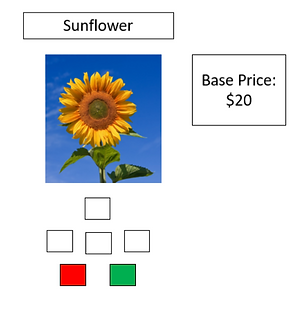
The Level System
The level system is the foundation of our idle game's player progression. Experience points that are required for leveling up are gained by harvesting flowers. Leveling up gives the player access to new flowers and tools to further advance their garden.
Our intended engagement for players is to give them a rapid start. Allowing them to power through levels in a short amount of time, eventually slowing down and have increased idle time as the levels increases. To replicate this effect, I implemented the following formula. (Where EXP gained equals the total currency given by a flower harvest)

Formula used for Leveling

Values used for Version 1.0

Values used for Version 1.0 visualised
Formula used for Leveling
The formula had 3 adjustable variables that the balance team could tweak to change the progression. Namely - the starting exp requirement, the growth factor, and the growth constant.
After version 1.0 release, we noted that the time to level up in the end-game was substantially longer as the logarithmic curve grew steeper as each levels increased. Several balance team members wanted the time between levels to decrease. A possible alteration to address this would be to provide separate EXP values for each flower harvest.
I also designed the UI elements for the level system. To give it life, I animated the level bar and presenting the player with a pop-up message when leveling up. The following diagram shows how I intended the visual elements to function. Level up was created using scriptable objects.
Creating the Quests
Quests were created to act as goals for players to work towards, while acting as a pseudo-guide to direct player towards their new unlocks. Quests were Quest went through multiple iterations through the entire development.
When implementing the functionality of the quests, I piggybacked existing code of other systems in our game such as adding progression counts for quests when placing down a new flower plot in the garden.

Flow diagram of Quest UI
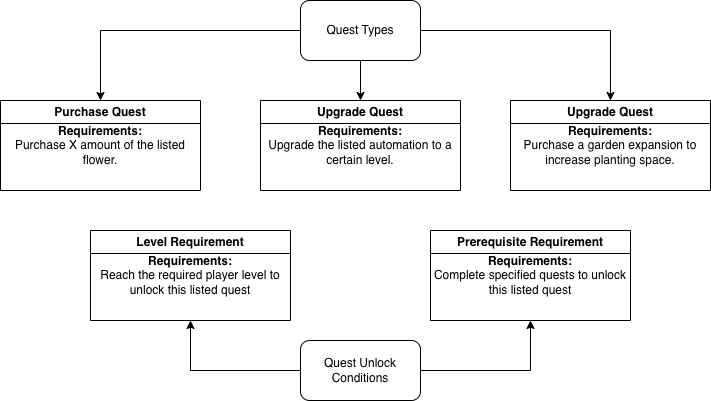
Basic functions of the quest system
Flow diagram of Quest UI
First phase: I designed Quests after the leveling system and therefore immediately used scriptable objects as well. However after several testing sessions, I learned that changing the values of scriptable objects in the scene would also change the stored values of the scriptable objects. Quests were then transitioned into a class.
Second phase: Quests unlock in sequence, quests only begin counting progression after it is unlocked. At some point quest only begin counting after the quest is read(requested by a game designer), this was changed back after a short period of internal testing and external play testing.
Third phase: I began focusing on the user experience side of the quest UI. Symbols representing state of the quest. Quest Notifications to draw player attention. The button to open quests was changed from a UI button to a clickable object in the garden.
Forth phase: At this point, quests tied in thematically to the narrative. Quests also begin counting progression before it is unlocked. A new condition to unlock quests was also introduced, prerequisite quests had to be completed before the next started.
Before Final version 1.0 release: Transitioned from vertical layout to a grid layout, quest text and values assigned, handed off final designs to main UI programmer.

Quest UI for Version 1.0 (Official Release)

Quest introduction letter for Version 1.0 (Official Release)

Quest details planning in GDD
Quest UI for Version 1.0 (Official Release)

Level Bar displaying EXP progress to next level
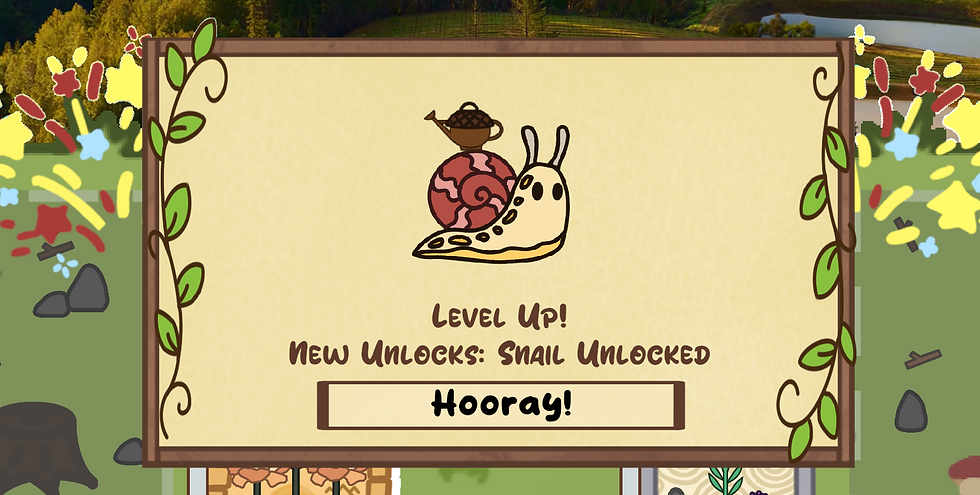
Window Pop Up when leveling up showing new unlocks with congratulatory effect
Level Bar displaying EXP progress to next level
Music and Sound effects
Being the most passionate about game music in our group, I was put in charge of communicating with our external music producer. My experience in music comes from ABRSM music theory and pure passion in game soundtracks.
To capture the thematic feel of our game, I directed our music producer towards soothing, calming fantasy music delivered by regional woodwind and string instruments. The main references I provided to the music producer were 'Monster Hunter: Freedom Unite's Pokke Village theme', 'Lord Of The Ring's Shire theme', and the additional reference of 'Chrono Cross's Arni Village-Home'.
The Sound effects I sourced were tracks under the creative commons license on royalty free websites. Sometimes the desired sound effects for a particular game interaction did not exist, therefore I had to edit several tracks using audacity to create it.
Initially, sound was implemented and managed under a sound manager, only using Unity's default audio playing component. With the help of a programmer's implementation, the final version managed sound through Unity's sound mixer, allowing player to adjust categorized volumes in settings.